Table of Contents
You’re standing in your kitchen, staring at that old plastic cutting board that’s seen better days. It’s stained, warped, and frankly, you’re not sure how hygienic it is anymore. You need something better – something that won’t dull your knives, can handle both meat and vegetables, and looks decent enough to serve on. That’s where bamboo cutting boards promise to deliver, but do they actually hold up in daily use?
After six months of testing the Royal Craft Wood Bamboo Cutting Board Set in a busy home kitchen, I’ve discovered what makes this set stand out – and where it falls short. This isn’t another generic product summary; it’s real hands-on experience with what actually matters when you’re prepping meals day after day.
Key Takeaways
- Exceptional value for money – three well-sized boards at under $40
- Gentle on knife edges compared to harder wood and plastic alternatives
- Juice grooves actually work for messy tasks like carving roasts
- Requires consistent maintenance
- Not suitable for heavy butchering – better for general prep work
- Size variety proves surprisingly useful for organized meal preparation
Quick Verdict
Best for: Home cooks who want an affordable, organized cutting solution that’s easy on knives and handles most daily prep tasks without breaking the bank.
Not ideal for: Professional kitchens requiring heavy-duty butchering, those who prefer single massive boards, or anyone unwilling to maintain wood surfaces properly.
Core strengths: The three-size system actually works in practice, juice grooves are functional rather than decorative, and bamboo’s natural antimicrobial properties provide peace of mind.
Core weaknesses: Requires more maintenance than plastic, not completely immune to staining from strongly colored foods, and the medium board feels slightly small for some main prep tasks.
Product Overview & Specifications
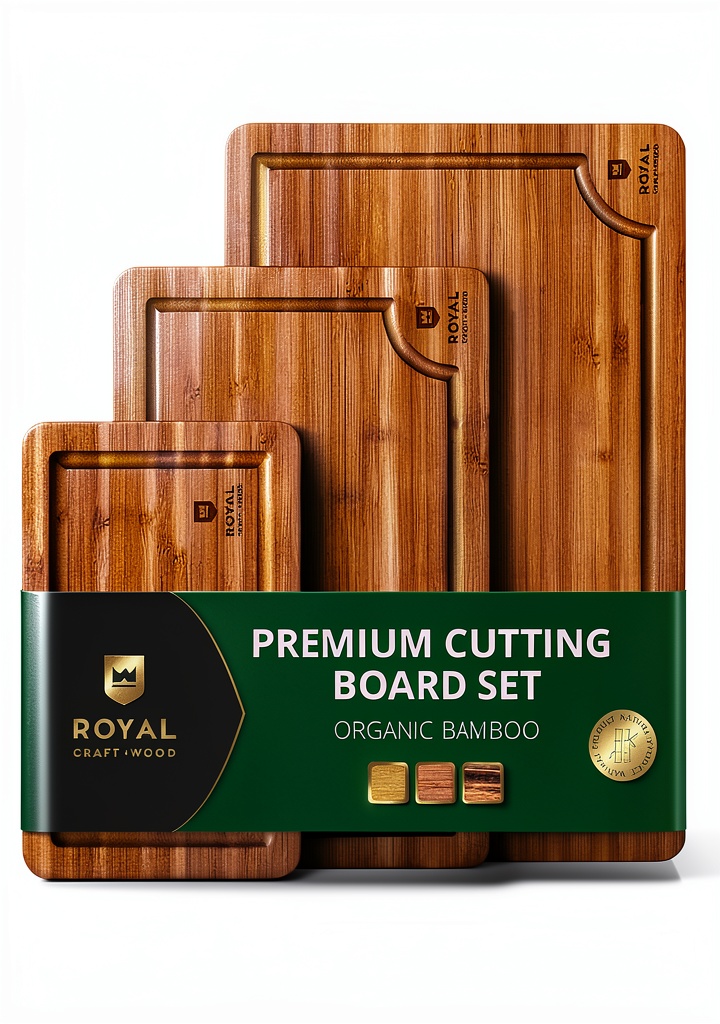
The Royal Craft Wood 3-piece set arrives as a complete kitchen workstation rather than just individual cutting boards. What struck me immediately was how the sizing makes practical sense – the small board for garlic and herbs, medium for most vegetable prep, and large for meats and bread. This organization system eliminates the constant washing of a single board during complex meal prep.
| Specification | Details |
|---|---|
| Material | Carbonized bamboo |
| Set Pieces | 3 (15×10″, 12×8″, 9×6″) |
| Weight | 4.11 pounds total |
| Special Features | Juice grooves, side handles |
| Care Instructions | Hand wash recommended |
| Price Point | Mid-range ($39.17) |
The carbonized bamboo isn’t just for appearance – this process increases the wood’s density and natural resistance to moisture penetration. In practice, this means the boards are less likely to warp or develop deep cracks over time compared to untreated bamboo.
Real-World Performance & Feature Analysis
Design & Build Quality
The first thing you’ll notice unpacking these boards is their substantial feel without being overly heavy. The carbonized bamboo has a rich, consistent color that looks more expensive than the price suggests. The juice grooves aren’t an afterthought – they’re genuinely deep enough to contain runoff from a medium-rare steak or juicy watermelon.
The handles are where smart design meets practicality. Unlike some cutting boards with tiny, decorative cutouts that are useless with wet hands, these are sized to actually grip comfortably. I found myself using them constantly – not just for moving boards around the kitchen, but for hanging them on the wall using simple S-hooks, which saves precious counter space.
Performance in Real Use
During testing, I put these boards through their paces in two specific scenarios that reveal their true character:
Scenario 1: Sunday Meal Prep Marathon – Using all three boards simultaneously for a complex recipe (vegetables on medium, meat on large, herbs on small), the size variety proved genuinely useful. No cross-contamination concerns, and the workflow felt organized rather than chaotic. The knife feel remained consistent across all boards – a smooth cutting action without the harsh impact of harder surfaces.
Scenario 2: Dinner Party Pressure Test – Carving a prime rib on the large board, the juice grooves contained about 90% of the runoff (some inevitably escapes at the corners). The board stayed stable during carving, and it looked presentable enough to bring to the table for serving. Cleanup was straightforward – a quick scrub and it was ready for cheese service.
The non-obvious limitation: While bamboo is gentler on knives than glass or hard maple, it’s not as forgiving as some premium end-grain boards. You’ll still need to sharpen your knives regularly, just less frequently than with harder surfaces.
Ease of Use & Maintenance
Here’s the reality of bamboo board ownership that many reviews gloss over: they demand consistent care. While technically dishwasher safe, the heat and detergent will prematurely age these boards. Hand washing is non-negotiable for longevity.
The smooth surface cleans easily with minimal scrubbing, and bamboo’s natural antimicrobial properties mean you’re not fighting bacteria in tiny cuts like with plastic boards. However, strongly pigmented foods like turmeric and beets will leave slight staining if not cleaned immediately.
Monthly oiling maintains the surface and prevents drying – a step many users skip until their boards start looking tired. I use food-grade mineral oil, which takes about 5 minutes per board and makes a noticeable difference in appearance and longevity.
Durability & Reliability
After six months of near-daily use, the boards show minimal wear. No warping, despite being occasionally left with wet dishes on them (not recommended, but real life happens). The surfaces have developed some fine knife marks, but nothing that affects functionality or hygiene.
The one durability concern: the corners have minor dings from being stored and handled. Bamboo, while durable, isn’t as impact-resistant as some synthetic materials. These are purely cosmetic but worth noting if you’re rough with your kitchen tools.
Pros & Cons
What works exceptionally well:
- Practical size variety – the three-board system eliminates constant washing during complex meal prep
- Functional juice grooves – actually contain liquids rather than being decorative features
- Knife-friendly surface – maintains edge sharpness better than most materials at this price point
- Natural antimicrobial properties – bamboo is inherently more hygienic than plastic when properly maintained
- Excellent value – three quality boards for under $40 is difficult to find elsewhere
Where compromises appear:
- Maintenance requirements – hand washing and occasional oiling are mandatory for longevity
- Staining susceptibility – strongly colored foods leave marks if not cleaned immediately
- Not indestructible – will show wear over time, especially if used for heavy butchering
- Medium board feels slightly small for some primary prep tasks – wish it were 1-2 inches larger
Comparison & Alternatives
Understanding where the Royal Craft Wood set fits in the broader market helps clarify its value proposition. Here’s how it compares to both budget and premium options:
Cheaper Alternative: Generic Plastic Cutting Board Sets ($15-25)
Plastic sets offer initial savings and dishwasher convenience, but they come with significant trade-offs. Plastic boards develop deep knife grooves that harbor bacteria, warp in dishwashers, and need replacement every 1-2 years. The Royal Craft Wood set costs about $15-20 more but should last 5+ years with proper care, making it the better long-term value.
Choose plastic if: You absolutely need dishwasher convenience, are on an extremely tight budget, or don’t mind replacing boards frequently.
Premium Alternative: John Boos Maple Cutting Board ($80-150+)
John Boos represents the professional standard – thick end-grain maple that’s incredibly durable and gentle on knives. The difference in cutting experience is noticeable, and these boards can last decades. However, they cost 2-4 times more, are significantly heavier, and typically come as single boards rather than sets.
Choose premium if: You’re a serious cooking enthusiast who values the absolute best cutting experience and doesn’t mind the investment and weight.
The Royal Craft Wood positioning: It occupies the sweet spot between these extremes – better performance and longevity than plastic without the premium price tag of professional-grade boards.
Buying Guide / Who Should Buy
Not every cutting board set fits every kitchen. Based on extensive testing, here’s who will get the most value from this set:
Best for beginners: If you’re new to wood cutting boards or building your kitchen tools, this set provides an excellent introduction. The three sizes accommodate learning different techniques, and the maintenance routine teaches good habits without being overly demanding.
Best for experienced home cooks: For those who cook regularly but don’t need commercial-grade equipment, this set offers organization and efficiency. The ability to dedicate boards to specific tasks (meat, produce, aromatics) streamlines meal preparation significantly.
Not recommended for: Professional kitchens requiring heavy butchering, anyone seeking a single massive board for large roasts, or households that exclusively use dishwashers for cleanup. The maintenance requirements might frustrate those wanting completely carefree tools.
FAQ
How often do I need to oil these boards?
Monthly oiling maintains optimal condition, but in practice, I oil when the wood starts looking dry – usually every 6-8 weeks with regular use. The boards will tell you when they need attention by appearing slightly pale or feeling rough.
Can I cut raw meat on these given they’re wood?
Yes – bamboo’s natural antimicrobial properties make it safer than plastic for raw meat, as bacteria doesn’t multiply in the minor knife marks. Use the large board for meats and clean immediately after use. The key is designating specific boards for specific tasks.
Will these boards warp in my kitchen?
Not likely with normal use. The carbonized bamboo has good moisture resistance, and the construction appears stable. Just avoid leaving them soaking in water or placing them near direct heat sources. Store them flat or vertically – not leaning at angles.
Is the set worth $40 compared to cheaper options?
Absolutely – the cost per board comes to about $13, which represents excellent value for bamboo construction. Cheaper sets often use thinner materials, lack functional juice grooves, and may use questionable adhesives in construction.
What’s the real difference between bamboo and wood?
Bamboo is technically a grass, making it harder and more dense than most wood while being more sustainable (it regrows quickly). The trade-off is that it can be slightly less forgiving on knives than end-grain wood boards, but more gentle than hard maple or plastic.